
 English
expand_more
English
expand_more
 Español
 Deutsch
 Français
 Português
 Türkçe
 Polski
 العربية
 हिन्दी

SEO in the Age of AI: How to Become a Top Source for Google AI and ChatGPT Search
In 2024, search is no longer just about a list of blue links. It is a battle for the attention of neural networks that generate answers on their own. If your website does not appear in AI-driven blocks such as Google AI Overviews or ChatGPT search results, you are losing clicks before users even reach your page.
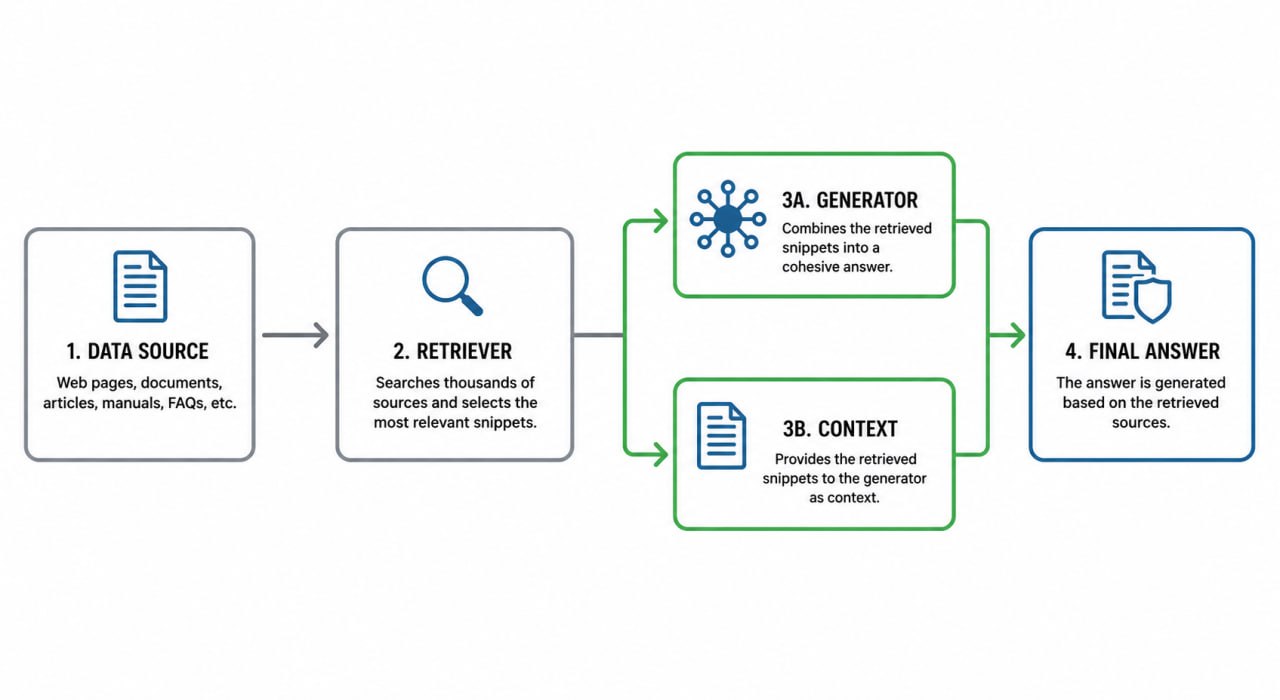
What does RAG have to do with it? This technology is at the core of modern AI-powered search engines. When a user asks a question, the neural network does not rely solely on its internal "memory" (like ChatGPT without internet access). Instead, it retrieves fresh data from the web in real time. RAG (Retrieval-Augmented Generation) is the engine that enables Google AI and other generative search tools not only to provide links but also to compile ready-to-read answers from snippets of your articles and other sources.
In this article, we will cover:
- how RAG systems work and why they now matter more than keywords;
- why reviews and expertise are becoming more important than backlinks (E-E-A-T redefined);
- how to optimise articles so that they are cited in Google AI, ChatGPT, and other generative answers;
- a step‑by‑step checklist for quickly updating your content.
How RAG Systems Build Search Answers
RAG (Retrieval-Augmented Generation) allows a neural network to generate responses based on up‑to‑date information from the internet. Instead of merely showing links, the AI processes the retrieved data and delivers a coherent, ready‑made answer.
How it works step by step:
Step 1. Query Expansion (key moment).
The AI does not search for fragments directly using your original query. First, the Retriever generates a list of semantically related search queries. This helps gather as much relevant information as possible from different angles.
- Example query: "How to choose a laptop for studying"
The system may expand it to roughly the following set of variants:- which laptop to choose for studying,
- best laptops for students,
- laptop for studying price quality,
- what specifications do I need for a study laptop,
- what to pay attention to when buying a laptop.
- Example query: "Cleaning company in Paris"
The system may expand it to something like this:- cleaning company for an apartment in Paris,
- order apartment cleaning in Paris,
- deep cleaning of an apartment,
- cost of apartment cleaning in Paris,
- cleaning company reviews in Paris,
- rating of cleaning companies in Paris,
- what is included in apartment cleaning,
- contract with a cleaning company,
- insurance for cleaning services.
Step 2. Retriever (fragment collection).
Using this expanded list of queries, the Retriever scans dozens of pages and extracts not the entire article, but only the most relevant paragraphs that directly answer the core question. A significant portion of these fragments may even come from the same website.
Step 3. Generator (answer assembly).
The Generator combines quotations from different sources, rephrases them, and presents the user with a single, structured answer.
The bottom line: Users see not a list of links but a ready‑made block with an answer. If your article is not well structured or does not address the expanded queries (see Step 1), the AI will ignore your content.
Why RAG Is Changing SEO Rules (and How to Turn It to Your Advantage)
RAG does not "kill" traditional SEO — it transforms it. It is no longer enough to simply gather keywords. You need to become a reliable data source for AI.
| Advantage | How to use it |
|---|---|
| AI only cites up‑to‑date information | Update your articles every six months (dates, figures, case studies). |
| AI loves structured content | Add FAQ sections, lists, and tables (AI finds it easier to "read" such content). |
| AI evaluates E-E-A-T more strictly than before | Include author bios, real reviews, and certificates. |
| You can "influence" the answers | Provide clear, comprehensive answers right at the beginning of your article. |
Mistakes That Reduce Your Chances of Being Cited in AI Answers
- No FAQ section. Users ask "How much does it cost?" but your article is just general text.
Fix: Add a question‑and‑answer block at the bottom of the page. - Weak E-E-A-T. The article has no author information or real testimonials.
Fix: Add the author's photo and a short bio. - Slow loading time. AI does not scan websites that take longer than 1 second to load.
Fix: Optimise images, enable caching, and upgrade hosting (requirements have become stricter!). - Duplicate content. The same text appears on multiple pages.
Fix: Write unique headings, subheadings, and examples for each page.
How to Write Articles That AI Will Cite
Rule #1: Answer the question within the first 3 paragraphs
- H1 heading: "How to Choose a Bicycle for City and Off‑Road"
- Short answer in the first paragraph: "For city and paved roads, hybrids or road bikes are the best choice. For rough terrain and forests, go with a mountain bike (MTB) or gravel bike. The key is to decide on your riding style, budget, and frame size. Below is a step‑by‑step guide to help you make the right decision."
- H2 subheading: "Step 1: Decide where and how you plan to ride (city, paved roads, off‑road)"
- FAQ block:
- Q: "How much does a good beginner bicycle cost?"
- A: "Entry‑level models start at around $500, mid‑range bikes are $1,000–$2,000, and professional ones go from $3,000 and above."
This approach gives AI both a direct answer, detailed guidance, and a block of common follow‑up questions — exactly what RAG systems look for when citing sources.
Rule #2: Add an FAQ section (AI loves it)
Example for an article "How to Choose a Server for Your Website":
- Q: "What is the minimum number of CPU cores I need?"
- A: "For a small online store — 4 cores; for a large enterprise — 8 or more."
Rule #3: Use structured data (Schema.org)
Example Schema code for FAQ:
<script type="application/ld+json">
{
  "@context": "https://schema.org",
  "@type": "FAQPage",
  "mainEntity": [{
    "name": "How much does hosting cost?",
    "acceptedAnswer": {
      "text": "From $5 per month."
    }
  }]
}
</script>
Checklist: Quick Adaptation of Your Site for RAG
Follow these steps to start taking traffic from your competitors in AI answer blocks.
- Check whether you appear in AI blocks. Search for your key queries in Google (in incognito mode). If the AI responses do not include citations from your site, it is time to revise your content. A service like Labrika can help you track your pages' positions in these blocks quickly.
- Build a semantic core of related questions. Remember query expansion (see examples above). Write down not only the main query but also 5–10 follow‑up questions that users may ask (as in the cleaning example: about contracts, insurance, scope of services).
- Add an FAQ block to your top‑10 pages. This block should cover all those related questions. Do not skip this — it is the richest source of material for AI.
- Update outdated articles. Take 3 articles that already bring traffic and add fresh figures (prices, dates, statistics). Labrika can show you which pages have lost positions — usually those with stale data.
- Improve loading speed to under 1 second. Check your speed using Labrika. If your site takes longer than 1 second to load — compress images, enable caching, switch hosting. This is critical for AI crawlers.
- Strengthen E-E-A-T. Add author photos, links to their social profiles, real customer reviews, and certificates to your pages. Without these, AI will not trust your content.
Expected result:
- Before: 1,000 visits per month (organic only).
- After: 3,000 visits (including traffic from AI answer blocks).
5 Secrets Known Only by Top SEO Professionals
- AI cites not only your main articles but also "thin" pages — such as separate pages with prices, instructions, and terms of service.
- The more reviews you have, the higher your chances of being included in AI answers. AI analyses mentions of your brand in reviews, even on third‑party platforms.
- A competitor with fresher content will outrank you in AI results. Even if you write better, if you only update once a year, AI will choose the newer article.
- It is not only about answers but also about format. AI does not just take text; it extracts structured data: tables, lists, and key figures highlighted in bold.
- Key takeaway: Your site must answer not only the main question (e.g., "cost of apartment cleaning") but also all related ones:
- "what is included in apartment cleaning",
- "contract with a cleaning company",
- "insurance for cleaning",
- "how to order apartment cleaning".
Conclusion: Your Action Plan for This Week
- Run an audit (check whether you are being cited in AI blocks — use Labrika or manual search).
- Add an FAQ section to 3 key pages, including related questions.
- Update one article (add examples, fresh data, and structure it under H2/H3 headings).
- Speed up your site to under 1 second load time (compress images and enable caching).
If you do this, you should start seeing an increase in traffic from generative AI answers within a month.
Bonus: Where to Find Ideas for Related Questions (FAQ)
- autocomplete suggestions from Google and the "People also ask" section;
- customer reviews (frequent questions and objections);
- competitors' "Frequently Asked Questions" sections.
Ready to adapt? Start with one section — and soon your content will be cited by AI‑powered search engines.